
When you’re considering firearms, understanding the difference between a pistol and a revolver is essential. These two types of handguns operate on distinct mechanisms and have unique designs. While pistols offer higher ammunition capacity and faster firing rates, revolvers bring reliability and simplicity to the table. Each has its merits and drawbacks, which can greatly impact your choice in various situations. So, which one suits your needs better? Let’s break it down further.
Mechanism of Operation
When comparing the mechanism of operation between a pistol and a revolver, you’ll notice distinct differences that affect performance and usability.
A pistol typically operates using a semi-automatic mechanism, where pulling the trigger both fires a round and cycles the action to chamber the next round. This means you can fire multiple shots quickly with minimal delay.
In contrast, a revolver relies on a rotating cylinder that holds cartridges. Each pull of the trigger rotates the cylinder to align a new round with the barrel. This design can be advantageous for reliability, but it generally results in slower firing rates.
Understanding these mechanics is essential for choosing the right firearm for your needs, whether it’s for sport shooting or self-defense.
Design and Structure
While both pistols and revolvers serve the same fundamental purpose, their design and structure reveal significant differences that influence their functionality and user experience.
A pistol typically features a semi-automatic design, where a single action fires one round with each trigger pull, automatically chambering the next round. Its frame is streamlined, often made from polymer or metal, allowing for a lighter and more compact profile.
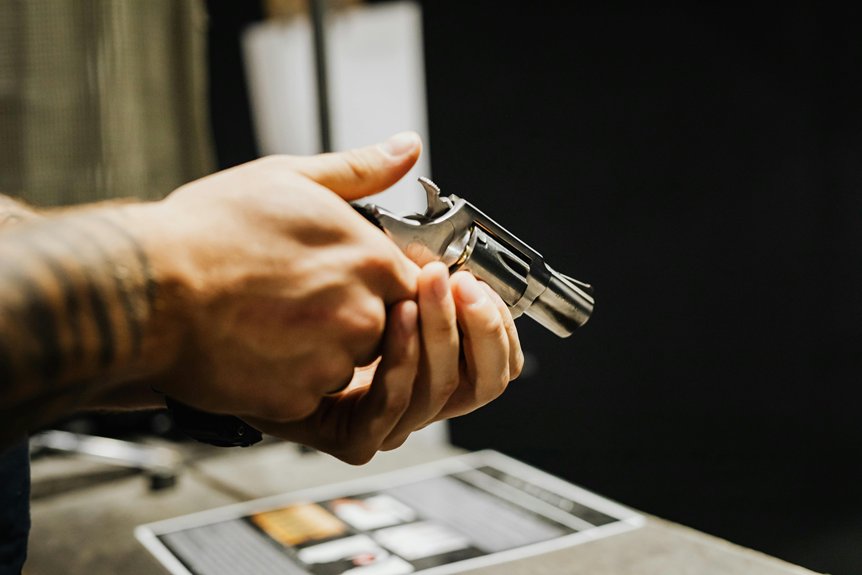
In contrast, a revolver has a rotating cylinder that holds multiple rounds, requiring a distinct action to advance the chamber. This structure adds weight and bulk, often resulting in a more robust feel.
The grips on revolvers are usually wider, while pistols often have ergonomic designs for ease of handling, catering to different preferences and shooting styles.
Ammunition Capacity
The design differences between pistols and revolvers greatly impact their ammunition capacity.
Generally, pistols offer a higher round count than revolvers due to their magazine-fed systems. Most semi-automatic pistols can hold between 10 to 20 rounds, depending on the model and magazine size.
In contrast, revolvers typically hold 5 to 6 rounds in their cylinder. This limitation arises from their mechanical design, which houses cartridges in a rotating cylinder rather than a detachable magazine.
While you might appreciate the simplicity and reliability of a revolver, it’s essential to take into account that a pistol’s higher capacity can provide an advantage in scenarios requiring sustained fire.
Ultimately, your choice will depend on your specific needs and preferences.
Reloading Process
How quickly can you reload your firearm? The reloading process varies greatly between pistols and revolvers.
When reloading a pistol, you typically eject the spent magazine, insert a new one, and rack the slide to chamber a round. This process can take just a few seconds with practice.
In contrast, reloading a revolver involves a different technique. You’ll need to open the cylinder, eject the spent cartridges, and insert fresh rounds into each chamber individually. This can be slower, especially if you’re using loose ammunition.
Understanding these differences is essential for improving your speed and efficiency, whether you’re training or in a critical situation.
Familiarizing yourself with both methods will enhance your overall firearms skills.
Typical Uses and Applications
Understanding the reloading process provides insight into how different firearms fit various scenarios.
Pistols are typically favored for self-defense and law enforcement due to their higher magazine capacity and faster reload times. Their semi-automatic design allows for quick follow-up shots, making them effective in high-pressure situations.
Conversely, revolvers excel in reliability and simplicity, often preferred for home defense or as backup weapons. They’re less prone to jamming and require minimal maintenance, which can be a deciding factor in critical situations.
Additionally, revolvers are commonly used in recreational shooting, such as cowboy action shooting, where their classic design adds to the experience.
Ultimately, your choice between a pistol and revolver should align with your specific needs and intended applications.