
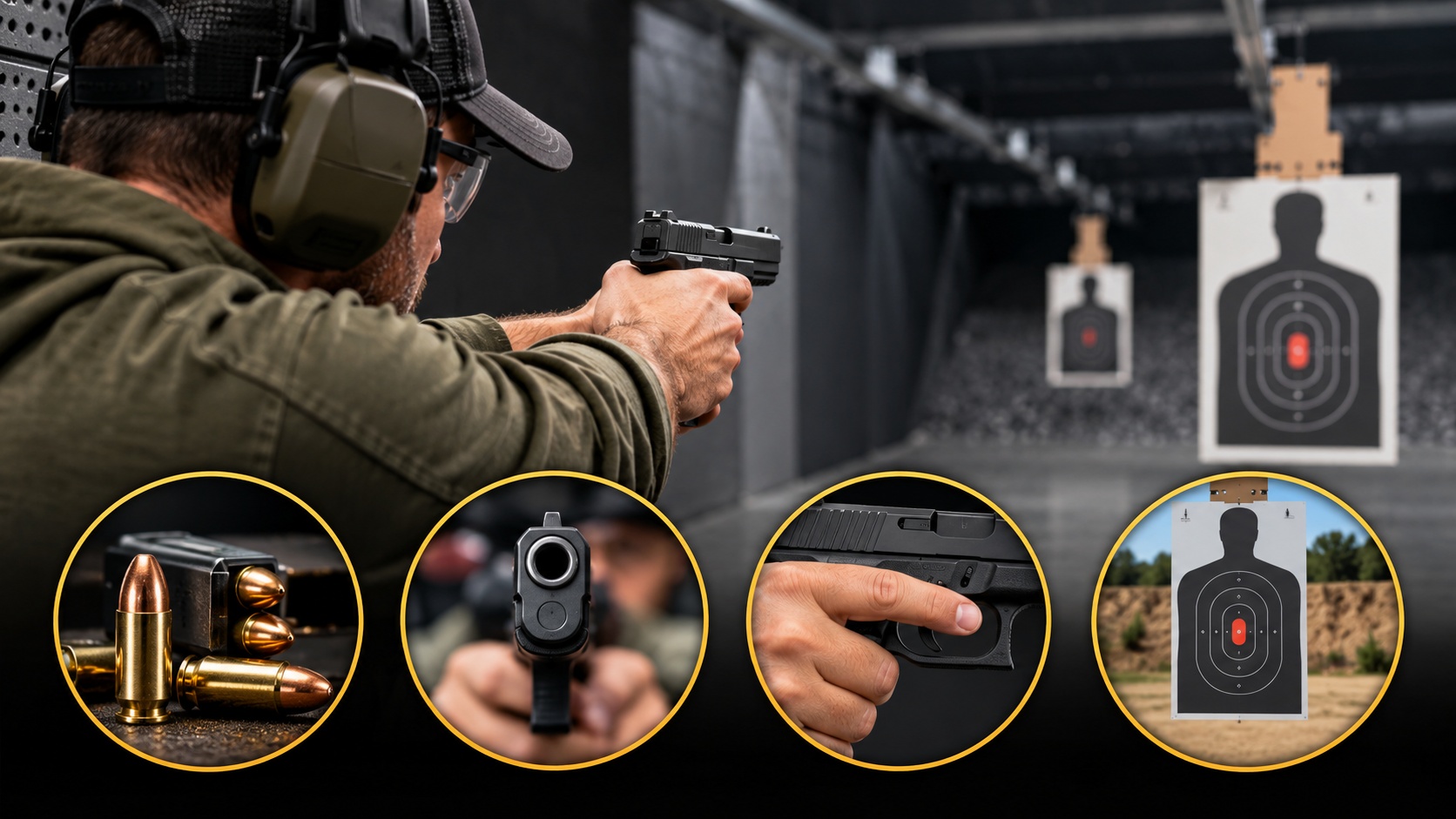
A good shooter isn’t defined by how fast they draw, what optic they run, or how much gear is hanging from their belt.
It starts with discipline.
Gun safety is the foundation of every other firearms skill. Marksmanship, concealed carry, home defense, tactical training, hunting and competitive shooting all depend on the same basic habits.
Those habits become especially important when things get busy.
You’re moving equipment around. Someone hands you an unfamiliar firearm. You’re loading magazines. A range goes cold. You’re tired after a long day of shooting.
That’s when ingrained safety procedures matter.
Fortunately, the core rules are simple.
BLUF: The 4 Rules of Gun Safety
The four fundamental rules of gun safety are:
- Treat every firearm as if it is loaded.
- Never point the muzzle at anything you are not willing to shoot.
- Keep your finger off the trigger until you are ready to fire.
- Know your target and what is beyond it.
Learn them until you don’t have to consciously think about them.
That’s the goal.
Good firearm safety should become automatic.
What Is Gun Safety?
Gun safety is the set of handling, storage and training practices used to reduce the risk of negligent discharges, injuries and unauthorized access to firearms.
But there is another way to think about it.
Gun safety is weapons discipline.
It means maintaining control of the firearm even when your attention is divided.
That includes knowing:
- whether the firearm is loaded
- where the muzzle is pointing
- where your trigger finger is
- what is in front of the firearm
- what is behind your target
- who can access the firearm
- how that particular firearm operates
The principles apply whether you’re carrying a compact handgun, zeroing a rifle, cleaning a shotgun or simply moving firearms in and out of a safe.
The 4 Rules of Gun Safety Explained
Rule 1: Treat Every Firearm as If It Is Loaded
Don’t trust assumptions.
A gun someone tells you is unloaded should still receive the same careful handling as a loaded firearm.
Even when you personally checked it earlier, continue treating it with respect.
This creates consistency.
If your handling changes dramatically depending on whether you think the firearm is loaded, eventually an incorrect assumption can become dangerous.
Instead, build one standard.
Every gun gets safe handling every time.
Whenever you take control of a firearm, keep the muzzle oriented safely and your finger away from the trigger while determining its condition according to the manufacturer’s instructions.
If you don’t know how a particular firearm operates, don’t guess.
Get instruction first.
Rule 2: Keep the Muzzle Pointed in a Safe Direction
Muzzle discipline is one of the clearest signs that someone knows how to handle a firearm.
You should always know where the muzzle is pointing.
Not approximately.
Not usually.
Always.
A safe direction is one where an unintended discharge would be unlikely to injure another person.
That direction changes depending on your environment.
At a shooting range, it will generally be downrange.
At home, in a vehicle, or outdoors, the situation can be different.
Floors, walls and other objects also aren’t automatically safe backstops. Many common building materials can be penetrated by projectiles.
The important principle is maintaining awareness of the muzzle throughout the entire handling process.
That includes:
- picking up the firearm
- loading
- unloading
- transporting it
- moving around other shooters
- clearing a malfunction
- placing it on a bench
- cleaning it
Your muzzle should never wander simply because your attention moved somewhere else.
Rule 3: Keep Your Finger Off the Trigger Until You’re Ready to Fire
This one should become muscle memory.
When you’re not actively preparing to fire, your trigger finger should remain straight and outside the trigger guard.
A good index position places the finger along the frame where it cannot accidentally contact the trigger.
This is especially important during movement and administrative gun handling.
People naturally tighten their hands when:
- startled
- losing balance
- grabbing something
- moving quickly
- experiencing stress
That’s exactly why your finger should not be resting on the trigger before you’ve made the decision to fire.
Trigger discipline gives you another layer of protection against an unintentional discharge.
Rule 4: Know Your Target and What Is Beyond It
The target is only part of the equation.
Before firing, you should understand what is:
in front of your target
around your target
behind your target
A projectile can miss.
It can pass through certain targets.
It can continue traveling much farther than you expected.
That’s why positive target identification and awareness of the background matter.
If you cannot clearly identify what you’re shooting at, don’t fire.
If you don’t know what’s behind it, don’t fire.
That rule applies at the range just as much as anywhere else.
Why the Four Gun Safety Rules Are Redundant
There’s a reason firearms instructors don’t rely on one safety rule.
The system has layers.
Imagine somebody makes the serious mistake of incorrectly assuming a firearm is unloaded.
Rule 1 has already failed.
But if they are still keeping the muzzle pointed safely, Rule 2 provides protection.
If their finger remains outside the trigger guard, Rule 3 provides another layer.
And if nobody fires without properly identifying the target and background, Rule 4 remains in effect.
That’s the point.
Good gun safety creates multiple barriers between a mistake and a bad outcome.
You can think of it as redundancy in any other safety system.
One safeguard is good.
Several independent safeguards are much better.
Where Is the Safety on a Gun?
One of the first questions new shooters ask is:
Where is the safety on this gun?
There isn’t one universal answer.
Different firearms use different safety systems.
Depending on the design, you might encounter:
- thumb safeties
- grip safeties
- trigger safeties
- cross-bolt safeties
- tang safeties
- internal drop safeties
- firing-pin blocks
- other internal mechanisms
Some firearms do not have an external manual safety at all.
That does not automatically make them unsafe.
It simply means their safety system operates differently.
Know Your Platform
Before handling an unfamiliar firearm, learn how that specific model operates.
Know:
- how its controls work
- how to determine its condition
- how its safety system functions
- how the manufacturer recommends loading and unloading it
Don’t assume controls work the same way just because two guns look similar.
And never use a mechanical safety as an excuse to ignore the four fundamental gun safety rules.
A safety lever is a mechanical device. Safe handling is a behavior.
You need both.
Administrative Gun Handling Deserves Extra Attention
A surprising amount of firearm handling happens when nobody is actually shooting.
You’re putting a gun into a case.
Removing it from storage.
Preparing for a range session.
Cleaning it.
Moving equipment around.
Changing holsters.
Showing a firearm to someone.
Those moments may feel routine, which is exactly why complacency can creep in.
Treat administrative handling with the same discipline you use on the firing line.
Slow down.
Control the muzzle.
Keep your finger clear.
Verify what you’re doing.
There is rarely any reason to rush routine firearm handling.
Gun Range Safety
A professional range environment gives you clear firing lines, backstops and procedures, but it also introduces other shooters.
That makes situational awareness essential.
Follow the range’s rules and listen to the range safety officer.
Basic range discipline includes:
- keeping firearms pointed downrange
- keeping fingers off triggers until ready to fire
- wearing eye protection
- wearing hearing protection
- obeying cease-fire commands immediately
- not handling firearms while people are downrange
- asking questions when you aren’t sure about a procedure
Never worry about looking inexperienced.
The dangerous shooter isn’t the person asking the instructor a basic question.
It’s the person who doesn’t know and decides to improvise.
What If the Gun Doesn’t Fire?
You press the trigger and nothing happens.
Don’t immediately start turning the firearm around trying to figure out what went wrong.
Maintain control.
Keep the firearm pointed in a safe direction.
Remove your finger from the trigger.
Then follow the manufacturer’s procedure or the instructions of your range safety officer or firearms instructor.
A firearm that failed to discharge should still be treated as potentially loaded.
The safety rules don’t disappear because something malfunctioned.
Safe Gun Storage Is Part of Firearm Readiness
Firearm safety continues when the range bag gets packed away.
A gun that isn’t under your direct control should be secured against unauthorized access.
That can include access by:
- children
- guests
- unauthorized family members
- burglars
- anyone else who should not be handling the firearm
Depending on your situation, secure storage might involve:
- a full-size gun safe
- handgun safe
- lock box
- locking gun cabinet
- secured firearm case
- appropriate firearm locking devices
The right setup depends on the firearm, your household and how the gun is used.
A hunting rifle locked away between seasons has different access requirements than a legally stored defensive handgun.
But the objective remains the same:
authorized access without unnecessary unauthorized access.
Hiding a Gun Isn’t the Same as Securing It
This deserves its own point.
A firearm hidden in a drawer or tucked onto a high shelf is not necessarily secure.
People find things.
Children explore.
Burglars know where people commonly hide valuables and firearms.
Proper storage should create an actual barrier to unauthorized access.
If keeping firearms in your home, check the storage laws that apply in your jurisdiction as well.
Gun Safety Around Children
Children should be taught that an unattended firearm is something they should never touch and should immediately tell a responsible adult about.
But education is not a substitute for secure storage.
Adults maintain responsibility for ensuring children cannot gain unauthorized access to firearms.
If firearms are kept in a home with children, consider safety as a layered system:
Education + supervision + secure storage
No individual layer should be expected to carry the entire burden.
Gear Doesn’t Replace Gun Safety
Tactical equipment can improve performance.
A good holster can provide retention and trigger protection.
Quality optics can improve target identification.
Weapon lights can assist in identifying things under appropriate conditions.
Safes and lock boxes can reduce unauthorized access.
But equipment can’t replace discipline.
You could own a $3,000 rifle with premium glass, a carefully built battle belt and the best shooting accessories available.
If your trigger finger is inside the trigger guard while you’re moving around other people, none of that gear matters.
The shooter is still the primary safety system.
That’s one of the most important principles in firearms training.
Gun Safety and Concealed Carry
Concealed carry introduces another environment entirely.
Your firearm now exists alongside normal life.
You’re getting in and out of vehicles.
Adjusting clothing.
Sitting down.
Standing up.
Walking through crowded areas.
Moving around family members.
That makes good equipment and disciplined handling especially important.
Use equipment designed for your firearm and carry method, and make sure you’re thoroughly familiar with both before carrying in public.
You should also understand the laws affecting concealed carry where you live and travel.
Laws vary substantially between jurisdictions and change over time.
Gun Safety and Home Defense
A firearm kept for defensive use creates its own safety considerations.
The owner has to balance accessibility with security.
There isn’t one storage solution that makes sense for every household.
The important questions include:
- Who lives in the home?
- Are children present?
- Who is authorized to access the firearm?
- How is unauthorized access prevented?
- Does everyone who may use the firearm understand how it operates?
- Has the owner considered where projectiles could travel inside the home?
Equipment alone doesn’t answer those questions.
Planning does.
Firearm Safety Training
Buying a firearm doesn’t automatically make someone competent with it.
Neither does watching videos.
For a new gun owner, formal firearm safety training is one of the best investments available.
A solid introductory class should cover topics such as:
- the four rules of gun safety
- firearm controls
- safe loading and unloading
- range procedures
- storage
- basic maintenance
- common malfunctions
- safe handling
- applicable firearm laws
Even experienced shooters can benefit from refresher training.
Skills fade.
Bad habits can creep in.
Equipment changes.
Training provides an opportunity to identify problems before they matter.
Common Gun Safety Mistakes
Most firearm safety failures aren’t dramatic.
They’re small lapses in discipline.
“I know it’s unloaded.”
Treat it safely anyway.
“The safety is on.”
Keep your finger off the trigger anyway.
“I’ve been shooting for 20 years.”
Experience is valuable, but familiarity can also create complacency.
“I’m only moving it for a second.”
Safety rules still apply.
“Nobody else is here.”
That’s exactly when you should be reinforcing the habits you’ll use when someone else is there.
“It’s just dry fire.”
Any dry-fire practice should begin with deliberate safety preparation and a proper environment. Follow the procedures recommended for your specific firearm and training setup.
Gun Safety FAQ
What are the 4 rules of gun safety?
The four primary gun safety rules are:
- Treat every firearm as if it is loaded.
- Keep the muzzle pointed in a safe direction.
- Keep your finger off the trigger until ready to shoot.
- Know your target and what lies beyond it.
What is the most important gun safety rule?
Rather than choosing one, treat all four rules as parts of the same safety system.
Their strength comes from redundancy.
If one layer fails, the others may still prevent someone from being injured.
What is gun safety?
Gun safety refers to the handling, training, storage and operational practices used to prevent negligent discharges, injuries and unauthorized access to firearms.
Where is the safety on a gun?
The location depends on the firearm.
Some firearms have external thumb, grip, cross-bolt or tang safeties. Other designs rely on internal or automatic safety systems and do not have an external manual safety.
Consult the owner’s manual for your specific firearm.
Should you treat an unloaded gun as loaded?
Yes.
Using the same fundamental safety habits regardless of a firearm’s believed condition reduces the chance that an incorrect assumption becomes dangerous.
Do experienced shooters still need firearm safety training?
Absolutely.
Experience does not eliminate the value of refresher training. Experienced shooters can still develop bad habits, change equipment or move into unfamiliar types of shooting.
Discipline Is Part of the Loadout
Firearms culture spends a lot of time talking about hardware.
Which pistol?
Which optic?
Which holster?
Which rifle?
Which light?
Those are worthwhile questions.
But none of that equipment sits higher on the priority list than safe gun handling.
The four rules remain simple:
Treat every firearm as loaded.
Control the muzzle.
Keep your finger off the trigger until you’re ready to fire.
Know your target and what is behind it.
Whether you’re running drills at the range, carrying concealed, preparing a home-defense firearm or simply moving a gun from the safe to a case, those rules don’t change.
Gear gives you capability.
Discipline keeps that capability under control.
This article is provided for general firearm-safety education and is not legal advice. Follow the manufacturer’s instructions for your firearm and all applicable federal, state and local laws.