
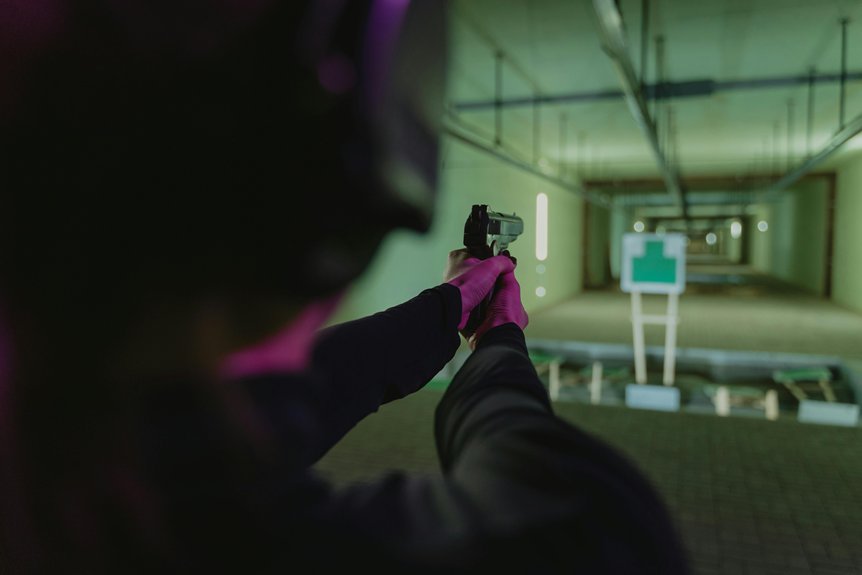
Aiming a pistol requires precision and practice. You’ll need to master the fundamentals, starting with your grip and stance. Proper sight alignment is essential, as is focusing on the front sight. Controlling your breath and executing a smooth trigger pull can greatly enhance your accuracy. As you refine these skills, you’ll notice areas for improvement. Understanding how to analyze your performance can make all the difference in hitting your target consistently.
Understanding the Basics of Pistol Aiming
When you’re aiming a pistol, understanding the fundamentals is essential for accuracy and safety.
Focus on your sight alignment, which involves centering the front sight in the rear sight notch while keeping your target in view. Confirm your sights are level, with the top of the front sight equal to the top of the rear sight.
Next, practice trigger control; apply steady pressure on the trigger without jerking it, as this can disrupt your aim.
Additionally, be aware of your breathing. Take a deep breath, then exhale partially before squeezing the trigger, as this helps stabilize your hold.
Finally, always keep your firearm pointed in a safe direction and maintain control throughout the aiming process to confirm safety.
Proper Grip and Stance
A proper grip and stance are essential for effective pistol shooting. Start by gripping the pistol with your dominant hand, ensuring your fingers wrap around the frame without excessive tension. Your index finger should rest alongside the trigger guard until you’re ready to shoot.
Use your non-dominant hand to support the grip, placing it firmly under the dominant hand, creating a solid two-handed hold.
Stand with your feet shoulder-width apart, positioning your non-dominant foot slightly forward. Bend your knees slightly and lean forward at the waist, keeping your body relaxed yet stable.
This stance lowers your center of gravity, improving balance and control. Maintain a straight posture, aligning your head over your feet to enhance stability while aiming.
Sight Alignment Techniques
Achieving effective sight alignment is essential to accurate shooting. To align your sights, position the front sight within the rear sight notch, guaranteeing they’re level and centered. Your goal is to create a straight line from the rear sight to the front sight, with equal space on either side of the front sight.
Focus on keeping the sights aligned while maintaining a consistent grip and stance. Remember, your dominant eye should be aimed directly down this line. Adjust your head position if necessary to guarantee comfort and clarity.
Practice this alignment technique regularly to build muscle memory, which will enhance your shooting accuracy. Consistency in sight alignment is vital for hitting your target reliably.
Focusing on the Front Sight
Focusing on the front sight is essential for improving your shooting accuracy. When you aim, make certain that your focus is sharp on the front sight, rather than the target or rear sight. This helps you maintain clarity and precision in your alignment.
As you establish your grip, bring the front sight into your line of vision, keeping it crisp and clear. Your rear sight and target will appear slightly blurred, which is perfectly normal.
Remember, your goal is to align the front sight with the target while keeping the rear sight in alignment. This technique aids in minimizing errors and enhances your overall shooting performance.
Consistent practice of this focus will lead to better accuracy over time.
Breath Control and Trigger Pull
Proper breath control and trigger pull are critical components of accurate shooting. As you prepare to fire, take a slow, deep breath, then exhale partially. This helps stabilize your body and reduces movement.
Hold your breath briefly before squeezing the trigger. Timing is essential; try to pull the trigger at the natural pause in your breath to minimize disruption.
When you pull the trigger, use the pad of your index finger and apply steady pressure. Avoid jerking or slapping the trigger, as this can cause your aim to shift.
Instead, focus on a smooth, consistent squeeze. This combination of proper breathing and controlled trigger pull enhances your accuracy, ensuring each shot lands where you intend.
Practicing Consistency
While mastering breath control and trigger pull is essential, practicing consistency in your shooting technique is equally important.
Focus on your stance, grip, and sight alignment each time you prepare to shoot. Establish a stable shooting position, ensuring your feet are shoulder-width apart and your body is balanced. Grip the pistol firmly yet comfortably, maintaining consistent pressure every time.
As you align your sights, keep your focus on the front sight, allowing the rear sight to blur slightly. Integrate these elements into your practice routine, aiming to replicate the same process for every shot.
Analyzing Your Results and Making Adjustments
After practicing consistency in your shooting technique, the next step is to analyze your results and make adjustments based on your performance.
Start by reviewing your target groupings. If your shots cluster to one side, it may indicate issues with your grip or sight alignment. Adjust your stance or adjust the sights accordingly if needed.
Next, evaluate the impact of your trigger pull. A jerky pull can lead to inaccuracies; focus on a smooth, deliberate squeeze.
Document your findings and track improvements over time. Experiment with minor adjustments to find what enhances your accuracy.